


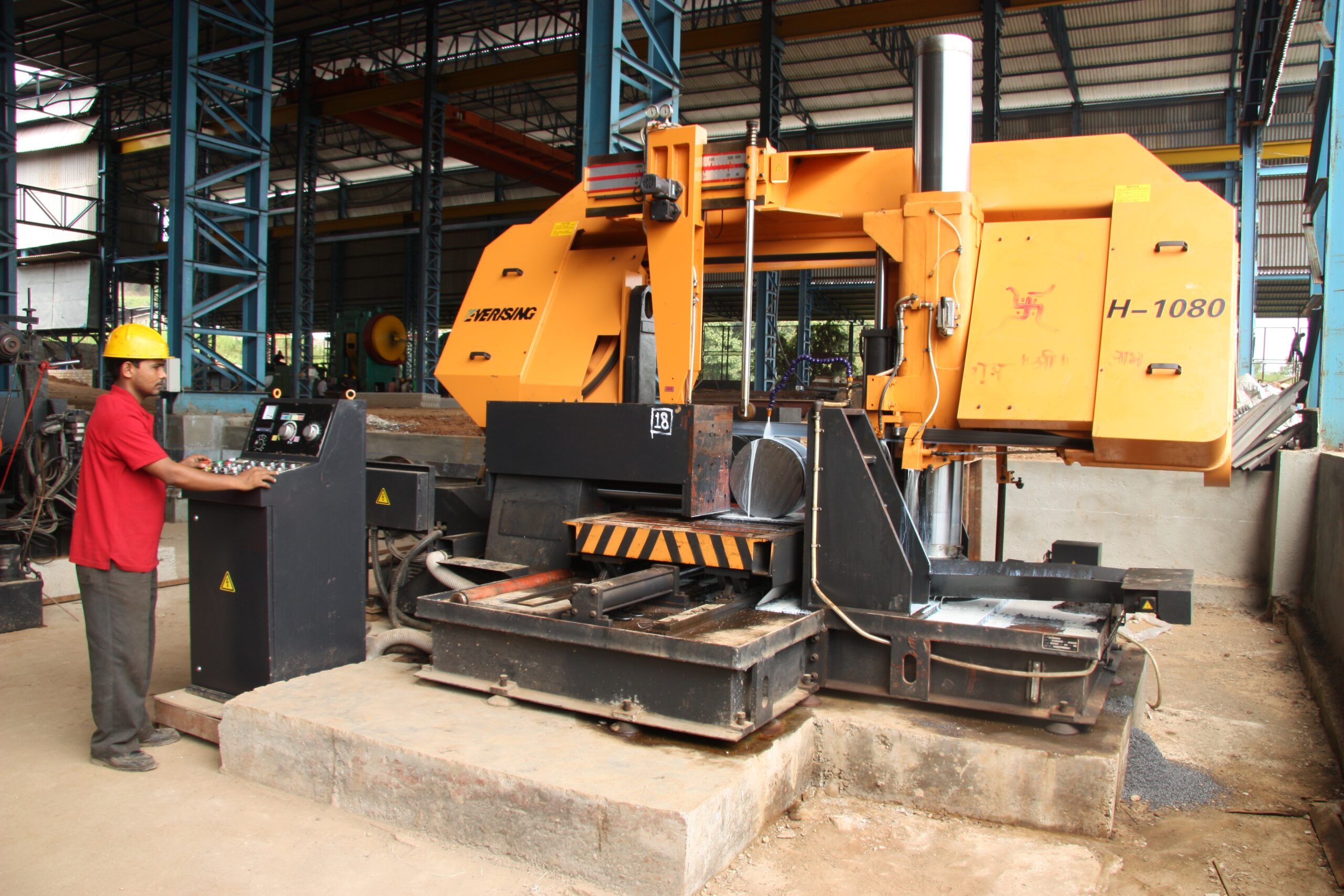
HMFL is equipped with high mechanized 16 Band Saw Machines capable of cutting from sizes 0.25” to 24” of Amada and Behringer for high end and precision cutting metals. Such machines are powered by an electric motor through a belt of transmission mechanism which creates a room for adjustment of belt speed. In a bandsaw machine, the workpieces are fed into the cutting edge of the machine. The bandsaw machine cuts the workpiece being fed by drawing a continuous toothed metal band across the workpiece at high speeds. The toothed steel blade on the bandsaw machine is driven by a drive wheel and is supported by an idler wheel. Because each tooth on the bandsaw blade is a precision cutting tool, the accuracy of machining can be expected to be high at close tolerances. This ability of the bandsaw machine eliminates or minimizes the utilization of many secondary machining operations. In addition to that, the chip removal process is very fast. When the bandsaw machine is turned on, the operator raises the saw and lowers the blade on the clamped material workpiece, cutting it through as the band blade moves. The bandsaw automatically switches off after the cutting operation is completed.

Forging is a manufacturing process where metal is pressed, pounded or squeezed under great pressure into high-strength parts known as forgings. The process is normally (but not always) performed hot by preheating the metal to a desired temperature before it is worked.
HMFL is well equipped with 2 Ton , 3 Ton Bell Drop Hammer , 2000 Ton Forging Press and 16000 Ton Russian Pneumatic hammer along with their respective trimming presses to cater to the wide varities of steel forging products across the globe ranging from size 1/2” to 24”. Each hammer is supported by separate pusher furnaces running on FuranceOil / Light Diesel Oil .
The metal is placed in a die and attached to an anvil. The hammer is dropped onto the metal, causing it to flow and fill the die cavities.
The hammer is timed to come into contact with the metal in quick succession on a scale of milliseconds. Excess metal is pushed out from the die cavities, resulting in a flash.The flash cools faster than the rest of the material, making it stronger than the metal in the die. After forging, the flash is removed.
In order for the metal to reach the final stage, it is moved through a series of cavities in a die:
• Edging impression (also known as fullering or bending): The first impression used to mold the metal into a rough shape.
• Blocking cavities: The metal is worked into a shape that more closely resembles the final product. The metal is shaped with generous bends and fillets.
• Final impression cavity: Final stage of finishing and detailing the metal into the desired shape.

HMFL serves as a home for 22 Computerized Numerical Control (CNC Machines) including 4 Vertical Lathe Machines and 6 Vertical Turning Lathes for getting the desirable physical composition as well as giving a smooth finishing on the interiors and exterior diameters of the product fir for industrial use.
A CNC machine is a motorized maneuverable tool and often a motorized maneuverable platform, which are both controlled by a computer, according to specific input instructions. Instructions are delivered to a CNC machine in the form of a sequential program of machine control instructions such as G-code and M-code, and then executed. The program can be written by a person or, far more often, generated by graphical computer-aided design (CAD) or computer-aided manufacturing (CAM) software. In the case of 3D printers, the part to be printed is “sliced” before the instructions (or the program) are generated. 3D printers also use G-Code.
CNC offers greatly increased productivity over non-computerized machining for repetitive production, where the machine must be manually controlled (e.g. using devices such as hand wheels or levers) or mechanically controlled by pre-fabricated pattern guides (see pantograph mill. However, these advantages come at significant cost in terms of both capital expenditure and job setup time. For some prototyping and small batch jobs, a good machine operator can have parts finished to a high standard whilst a CNC workflow is still in setup.

The process of heat treatment involves heating of solid metals to specified(recrystallization)temperatures holding them at that temperature and then cooling them at suitable rates to enable the metals to acquire the desired properties to the required extents.
HMFL is well equipped with 4 Heat Treatment furnaces as well as Oil and Water Quenching Tank to achieve the desirable chemical composition of the material as per the required standards of the clients. which is run on LDO All this takes place because of the changes in size, form, nature, and the distribution of different constituents in the microstructure of these metals. All heat treatment processes, therefore, comprise the following three stages of components:
Stages of heat treatment Process :
1. Heating the metal to a predefined temperature.
2. Holding it at that temperature for sufficient time so that the structure of the metal becomes uniform throughout.
3. Cooling the metal at a predetermined rate in a suitable media to force the metal to acquire a desired internal structure and thus, obtain the desired properties to the required extent. All this takes place because of the changes in size, form, nature, and the distribution of different constituents in the microstructure of these metals.
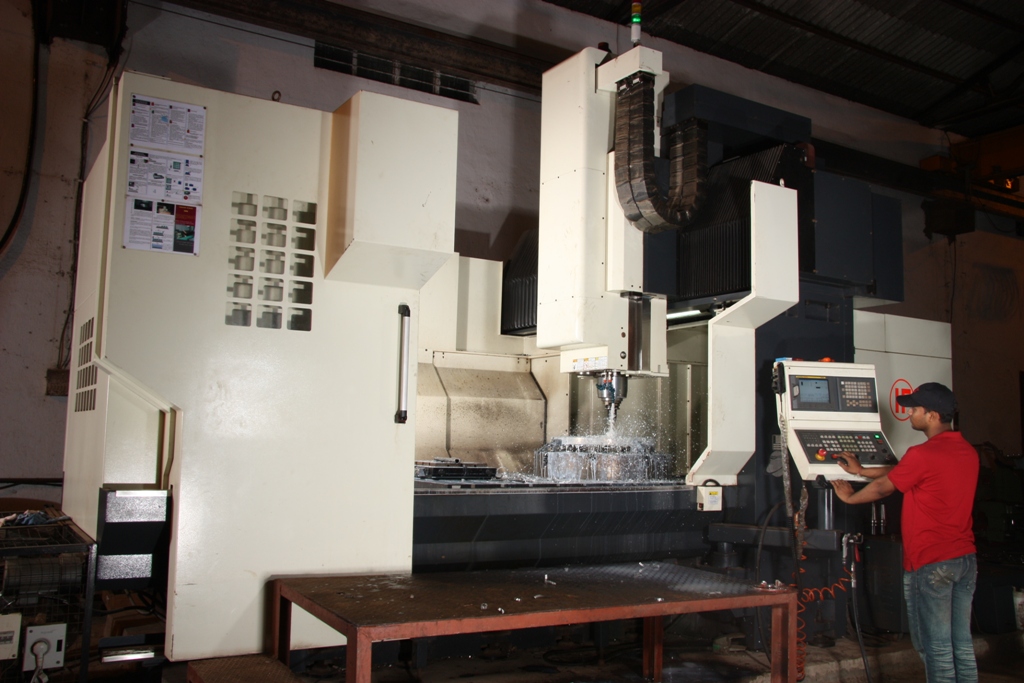 HMFL has in-house set up of VMC Machines for proper designing and manufacturing of dies used in the forging process which is supervised by the in-house design team for manufacturing all types of dies for catering the requisite needs of the customers on all fronts.
A die is a specialized machine tool used in manufacturing industries to cut and/or form material to a desired shape or profile. Stamping dies are used with a press as opposed to drawing dies (used in the manufacture of wire) and casting dies which are not. Like molds, dies are generally customized to the item they are used to create.
Products made with dies range from simple paper clips to complex pieces used in advanced technology. Continuous-feed laser cutting may displace the analogous die-based process in the automotive industry among others.
HMFL has set-up in-house laboratory facility to check the chemical composition of the raw material as well as the physical composition and chemical composition of the final product before / at the time of dispatch as per the needs of the customers. Our advanced laboratory is equipped with the latest technology and staffed by a team of experts dedicated to providing accurate and reliable results. We cater to a wide range of industries, including aerospace, automotive, energy, and manufacturing, ensuring that your materials are tested with the highest level of precision.
With our NABL accreditation, you can trust that our testing processes adhere to international standards, providing you with the confidence you need in your materials’ performance and quality. From routine assessments to specialized research and development, HMFL has all the equipments to fulfil the testing requirements.
 HMFL has appointed trained specialists for appropriate quality testing in the physical compositions of the products before dispatch and are loaded in the boxes which are either exported to the customers or sold in the domestic market based on the type of packaging the customer prefers. The department has installed laser stamping and hard stamping to identify the types of products for ease of the customers and the team.